Political systems within the Second Reich
Following unification of Germany in 1871 the political structure of the Second Reich was roughly as follows:
The Second Reich was made up of 25 German states. Each of these retained its own Prince, as each had previously been a Princedom. These states were represented on a National Level by the Reichsrat, the upper house of legislative Parliament.
The Kaiser in the Second Reich
The Head of State was the Kaiser. This role was an hereditary one based upon the old Kingdom of Prussia. The Kaiser had the right to summon the Reichstag and dismiss it as and when he felt appropriate. He also had the power to appoint and dismiss the Chancellor and all government ministers. It was these Ministers who would propose legislation to the two houses of Parliament.
The Reichstag and Reichsrat
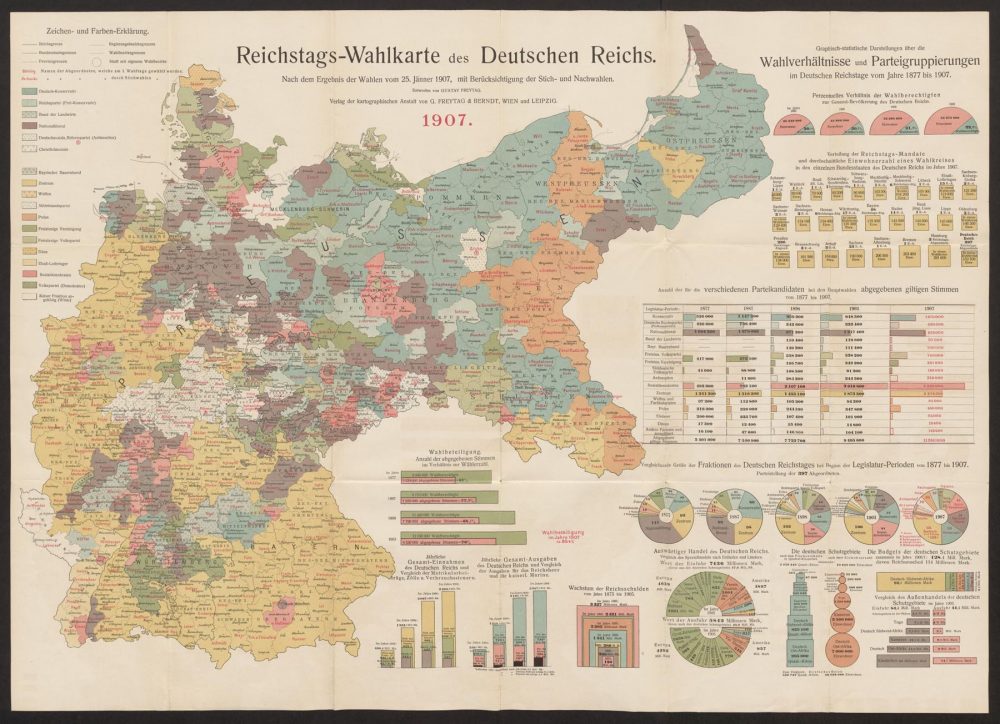
The Reichstag was the main legislative body. This institution was democratically elected every 3 years, with all men over the age of 25 having the vote. This body debated issues and voted on proposed legislation. The Reichsrat had the power to veto legislation passed by the Reichstag.
Each State within the Reich had its own local legislative body that dealt with local issues.
In brief, the legislative bodies worked something like this:
|
The Kaiser
|
|||||
|
The Reichstag
|
The Reichsrat
|
The chancellor and government ministers |
|||
|
Elected by Universal Male Suffrage every 3 years (Voting age was 25) The Kaiser was able to summon and/ or dismiss the Reichstag.
|
Was an assembly of the representatives of the 26 states that made up the Unified Germany. One representative from each state was a member of the Reichsrat. The Reichsrat had the right to veto Legislation passed by the Reichstag.
|
Appointed directly by the Kaiser. They proposed legislation to be passed by the reichstag.
|
|||
Germany 1919 – 1945 Links
The Second Reich
Unification of Germany – Political systems within the Second Reich – German Society during the Second Reich – Collapse of the Second Reich
Weimar Republic
Interim Government – Founding of the Weimar Republic – Impact of the First World War on Germany – The Treaty of Versailles and its impact on Germany – Weimar Constitution1919-1923: Years of Crisis? – Spartacist Uprising – Kapp Putsch – Reichsbanner Schwarz-Rot-Gold – Reparations – Hyperinflation in Germany, 1923 – 1924-1928: A Golden Era? – 1925 Presidential Election – Gustav Stresemann – German Foreign Relations 1919-1932 – Germany in the Great Depression – Failings of the Weimar Republic – Dada Movement
Rise of the Nazi Party
The Munich Putsch – Did the Economic Crisis of 1923 help the Nazi’s? – Origins of the Nazi Party – Rise of the Nazi Party
Nazi Germany
Totalitarian Regime in Nazi Germany – How did Hitler consolidate power? – Mein Kampf – Nazi methods of control – Opposition to the Nazi Regime – Organisation of the Nazi Party – Fuhrerprinzip – Kristallnacht – Youth and Education – Goering and the 2nd 4 Year Plan – Anti-Jewish Boycott, 1933 – Nazi Anti-Semitism – DAF (The German Labour Front) – Propaganda in Germany 1919-39 – Economic Policy of the Nazi Party – Kreisau Circle – The Confessing Church – Catholic Church – Edelweiss Pirates
Biographies
Ludwig Beck – Dietrich Bonhoeffer – Bishop Clemens von Galen – Carl Goerdeler – Robert Ley – Helmuth von Moltke – Martin Niemoller – Erwin Rommel – Hjalmar Schacht – Sophie Scholl – Albert Speer – Claus von Stauffenberg – Fritz Todt