The Dada Movement was an artistic movement that originated in Zurich during the First World War. Dada was deep rooted in protest about the war. Dadaist artists emerged in many countries, particularly in Germany, Central Europe and in North America. Dada art in Germany was largely centred in Berlin.
The Dada Movement
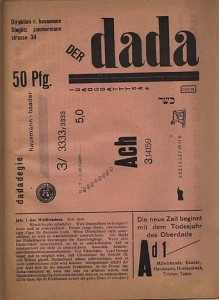
Origin of the Dada Movement
Dadaism started in Zurich in 1916 at a Nightclub called Caberet Voltaire. As Zurich was in neutral Switzerland it attracted disaffected artists, musicians and writers from across Europe. In the relative safety of Zurich they could meet, discuss their thoughts and freely express their opinions about the war and other issues.
The Dada Movement made its first known appearance in Germany in 1918 when Huelsenbeck gave a speech about Dada to an audience in Berlin. Soon, other artists and writers were using the Dada principles to express their feelings. Some, like George Grosz and Hannah Hoch used Dada to explore their political feelings.
Exhibitions
In 1920 a large exhibition of over 200 pieces of Dada artwork was held in Berlin. The exhibition failed to make a profit, but is noted as a significant point in the development of the Dada movement. Following the Rise of the Nazi Party several pieces of artwork from this Dada exhibition were presented by the Nazi’s in their 1937 exhibition, Entartete Kunst, in which the Nazi Party showed artwork that they considered to be decadent and against the German people.
The Dada Movement in Germany at this time is important for several reasons. The artwork and pamphlets created by the movement illustrate the discontent of many Germans. It can be used to look at some aspects of German Society and the underlying feelings of people at the extremes of the political spectrum.
Leading Dada Movement artists in Germany at the time include:
- George Grosz
- Hannah Hoch
- Johannes Baader
- Huelsenbeck
Germany 1919 – 1945 Links
The Second Reich
Unification of Germany – Political systems within the Second Reich – German Society during the Second Reich – Collapse of the Second Reich
Weimar Republic
Interim Government – Founding of the Weimar Republic – Impact of the First World War on Germany – The Treaty of Versailles and its impact on Germany – Weimar Constitution – 1919-1923: Years of Crisis? – Spartacist Uprising – Kapp Putsch – Reichsbanner Schwarz-Rot-Gold – Reparations – Hyperinflation in Germany, 1923 – 1924-1928: A Golden Era? – 1925 Presidential Election – Gustav Stresemann – German Foreign Relations 1919-1932 – Germany in the Great Depression – Failings of the Weimar Republic – Dada Movement
Rise of the Nazi Party
The Munich Putsch – Did the Economic Crisis of 1923 help the Nazi’s? – Origins of the Nazi Party – Rise of the Nazi Party
Nazi Germany
Totalitarian Regime in Nazi Germany – How did Hitler consolidate power? – Mein Kampf – Nazi methods of control – Opposition to the Nazi Regime – Organisation of the Nazi Party – Fuhrerprinzip – Kristallnacht – Youth and Education – Goering and the 2nd 4 Year Plan – Anti-Jewish Boycott, 1933 – Nazi Anti-Semitism – DAF (The German Labour Front) – Propaganda in Germany 1919-39 – Economic Policy of the Nazi Party – Kreisau Circle – The Confessing Church – Catholic Church – Edelweiss Pirates
Biographies
Ludwig Beck – Dietrich Bonhoeffer – Bishop Clemens von Galen – Carl Goerdeler – Robert Ley – Helmuth von Moltke – Martin Niemoller – Erwin Rommel – Hjalmar Schacht – Sophie Scholl – Albert Speer – Claus von Stauffenberg – Fritz Todt –