Helmoth von Moltke was a German aristocrat from a highly regarded and famous family. He became a leading figure in the opposition movement known as the Kreisau Circle. In 1945 Helmoth von Moltke was executed for treason, having been found guilty by the Peoples Court of plots against Hitler.
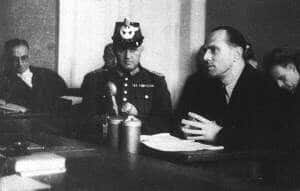
Helmuth von Moltke
Helmuth von Moltke trained as a lawyer. He specialised in International Law. From qualifying in 1934 through to the outbreak of the war and his conscription into the Abwehr in 1939, he used this role to help people who were being persecuted leave Germany. He also travelled to England regularly to complete further legal training at Oxford. This provided him with contacts that would be of use in the coming years.
When war broke out, Helmuth von Moltke was drafted into the Abwehr, one of the intelligence organisations. His role utilised his experience as a specialist in International Law. He was to gauge international opinion and act as liaison between his unit, the Counter Intelligence Division (Foreign) and the Foreign Ministry.
Helmuth von Moltke observes atrocities in the East
These roles required von Moltke to travel extensively through occupied Europe: chiefly in the East. Helmuth von Moltke witnessed many Human Roghts abuses on these travels and was well aware of the persecution of Jews and political opponents in the occupied territories. As a devout christian, these abuses disturbed him. He used his role to write reports about the negative impact of the methods on German soldiers and urged for the Geneva Convention to be adhered to. He noted that repeated German violations of the Geneva and Hague Conventions would almost certainly result in German soldiers who were captured being badly treated.
Passing reports to the Allies
Helmuth von Moltke’s opposition to the regime grew. In 1943 he used an official Abwehr visit to Turkey as a means to pass documents to the Americans. In these he outlined the situation in Germany and the nature of abuses occurring on the Eastern Front. His documents found their way as high as President Roosevelt, though their credibility was questioned at the time.
Kreisau Circle
At the same time as he was objecting to human rights abuses through his work for the Abwehr, Helmuth von Moltke was also developing a network of like minded people. This group, the Kreisau Circle, discussed a range of issues. Most were related to the abuses of the Nazi regime and their vision for a post Hitler Germany. The group comprised military officials that von Moltke knew from his work; other people from Aristocratic backgrounds; Government officials and opponents from within the church.
The group wrote, but not published until long after the war, a set of principles that read like a manifesto. It describes the groups vision for a fair and just, Christian, Germany. The groups work is discussed in more detail in this post about the Kreisau Circle.
Arrest and execution of Helmuth von Moltke
Helmuth von Moltke was arrested by the Gestapo in January, 1944, for tipping someone off that they were about to be arrested. He was later charged with treason, following the unsuccessful July Bomb Plot. Even though no evidence was available that he had been involved in plotting to assassinate Hitler, he was found guilty of treason on the grounds that he had discussed a Germany without Hitler as leader. He was executed in January, 1945.
Germany 1919 – 1945 Links
The Second Reich
Unification of Germany – Political systems within the Second Reich – German Society during the Second Reich – Collapse of the Second Reich
Weimar Republic
Interim Government – Founding of the Weimar Republic – Impact of the First World War on Germany – The Treaty of Versailles and its impact on Germany – Weimar Constitution – 1919-1923: Years of Crisis? – Spartacist Uprising – Kapp Putsch – Reichsbanner Schwarz-Rot-Gold – Reparations – Hyperinflation in Germany, 1923 – 1924-1928: A Golden Era? – 1925 Presidential Election – Gustav Stresemann – German Foreign Relations 1919-1932 – Germany in the Great Depression – Failings of the Weimar Republic – Dada Movement
Rise of the Nazi Party
The Munich Putsch – Did the Economic Crisis of 1923 help the Nazi’s? – Origins of the Nazi Party – Rise of the Nazi Party
Nazi Germany
Totalitarian Regime in Nazi Germany – How did Hitler consolidate power? – Mein Kampf – Nazi methods of control – Opposition to the Nazi Regime – Organisation of the Nazi Party – Fuhrerprinzip – Kristallnacht – Youth and Education – Goering and the 2nd 4 Year Plan – Anti-Jewish Boycott, 1933 – Nazi Anti-Semitism – DAF (The German Labour Front) – Propaganda in Germany 1919-39 – Economic Policy of the Nazi Party – Kreisau Circle – The Confessing Church – Catholic Church – Edelweiss Pirates
Biographies
Ludwig Beck – Dietrich Bonhoeffer – Bishop Clemens von Galen – Carl Goerdeler – Robert Ley – Helmuth von Moltke – Martin Niemoller – Erwin Rommel – Hjalmar Schacht – Sophie Scholl – Albert Speer – Claus von Stauffenberg – Fritz Todt