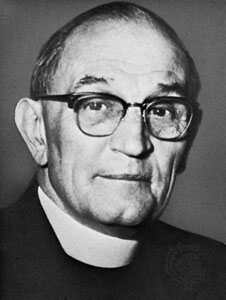
Martin Niemoller resisted the Nazi’s through peaceful protest. He preached about the freedom of the Church; he assisted in the convening of some 7000 pastors to discuss resistance to changes in the church and he was a founder of the Confessing Church.
Martin Niemoller
Some members of the German Protestant Church wanted to integrate Nazi doctrine into the church. The Nazi Party was also quite eager to exert influence via the church, setting up it’s own Reichs Church. In 1933 Niemoller was one of the founders of an organisation of pastors called Pfarrernotbund. This was intended to be a convening of pastors to combat the interference of the state in Church affairs. This was a response to Hitler ordering the re-election of Church officials to local synods. The elections were heavily biased towards pro-nazi candidates.
Niemoller and the rights of the Church in Nazi Germany
Niemoller, and many other Pastors, opposed some of the actions that the newly elected church leadership were taking. In particular was the ‘Aryan Paragraph’. This was a paragraph in a church law that restricted the rights of Jews who had converted to Christianity.
Along with other Protestant Germans, Niemoller helped to form the Confessing Church. This Church, founded in 1934, stood in opposition to the changes that were being forced upon the traditional Protestant churches in Germany.
In 1936, Niemoller was one of the Pastors who signed a petition against the Aryan paragraph. The petition denounced the Aryan Paragraph as being incompatible with Christian beliefs. The petition resulted in over 800 people being arrested by the Gestapo.
Arrest of Martin Niemoller
Throughout this period, Niemoller also preached about his beliefs. On June 27th, 1937, he spoke out in public. He was arrested on July 1st. Niemoller than spent the rest of the Third Reich imprisoned, finally being liberated on 5th May, 1945.
Martin Niemoller’s resistance to the Nazi’s was mainly on the grounds of religious freedom for his church. After his liberation, he admitted that he had no political argument with Hitler, or the Nazi Party. When he spoke out, which he did regularly, it was in defence of other Pastors, or to defend the rights of the Church.
Post War Reflection: Niemoller’s famous verse
Indeed, it is only after the war and his liberation that Niemoller was able to reflect on his own views and the way that Germany had changed under the Nazi’s.It was at this time that his now famous verse, was first penned: it can be traced to a sermon in 1946.
First they came for the socialists, and I did not speak out—because I was not a socialist.
Then they came for the trade unionists, and I did not speak out—because I was not a trade unionist.
Then they came for the Jews, and I did not speak out—because I was not a Jew.
Then they came for me—and there was no one left to speak for me.
—Martin Niemöller
That verse is now often used as an example of German resistance to the Nazi’s – despite the fact it as first used some 8 months after Hitler’s suicide. You may see a number of different versions of the poem. This is not because of poor translation, it is because Niemoller rewrote it several times to suit different audiences.
Links
Holocaust Memorial Day Trust – Martin Niemoller
Germany 1919 – 1945 Links
The Second Reich
Unification of Germany – Political systems within the Second Reich – German Society during the Second Reich – Collapse of the Second Reich
Weimar Republic
Interim Government – Founding of the Weimar Republic – Impact of the First World War on Germany – The Treaty of Versailles and its impact on Germany – Weimar Constitution – 1919-1923: Years of Crisis? – Spartacist Uprising – Kapp Putsch – Reichsbanner Schwarz-Rot-Gold – Reparations – Hyperinflation in Germany, 1923 – 1924-1928: A Golden Era? – 1925 Presidential Election – Gustav Stresemann – German Foreign Relations 1919-1932 – Germany in the Great Depression – Failings of the Weimar Republic – Dada Movement
Rise of the Nazi Party
The Munich Putsch – Did the Economic Crisis of 1923 help the Nazi’s? – Origins of the Nazi Party – Rise of the Nazi Party
Nazi Germany
Totalitarian Regime in Nazi Germany – How did Hitler consolidate power? – Mein Kampf – Nazi methods of control – Opposition to the Nazi Regime – Organisation of the Nazi Party – Fuhrerprinzip – Kristallnacht – Youth and Education – Goering and the 2nd 4 Year Plan – Anti-Jewish Boycott, 1933 – Nazi Anti-Semitism – DAF (The German Labour Front) – Propaganda in Germany 1919-39 – Economic Policy of the Nazi Party – Kreisau Circle – The Confessing Church – Catholic Church – Edelweiss Pirates
Biographies
Ludwig Beck – Dietrich Bonhoeffer – Bishop Clemens von Galen – Carl Goerdeler – Robert Ley – Helmuth von Moltke – Martin Niemoller – Erwin Rommel – Hjalmar Schacht – Sophie Scholl – Albert Speer – Claus von Stauffenberg – Fritz Todt