The Interim Government of Germany began on November 9th 1918 when Prince Max von Baden, the Imperial Chancellor, announced the abdication of Kaiser Wilhelm and the Crown Prince. He also transferred his own position of Chancellor to Fredrich Ebert, leader of the SPD. This created an interim system of governance which was to last until what is known as the Weimar Republic’s Constitution was introduced.
Ebert’s Coalition Interim Government
Ebert immediately set about forming a coalition government that could administer Germany in the interim. He made an agreement with the USPD, a Socialist party, which placated many of the disillusioned workers, soldiers and sailors. Workers and soldiers councils confirmed this on 10th November. Also on 10th November the armed forces agreed to support the new government, on the understanding that the government would support the High Command in its attempts to preserve high levels of discipline within the forces (Mutinies were common at this point, see notes on the problems Weimar faced upon its inception).
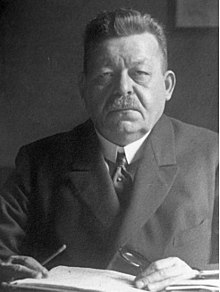
The interim government was faced almost immediately with problems. In December the left wing Spartacist group held a demonstration that had to be suppressed by use of armed forces. In January this group again threatened the fledgling government, as the Spartacist Uprising occurred. Again the interim government made use of force quell the rebellion. Following the successful defeat of the Spartacists elections were held across Germany for the National Assembly.
Germany 1919 – 1945 Links
The Second Reich
Unification of Germany – Political systems within the Second Reich – German Society during the Second Reich – Collapse of the Second Reich
Weimar Republic
Interim Government – Founding of the Weimar Republic – Impact of the First World War on Germany – The Treaty of Versailles and its impact on Germany – Weimar Constitution1919-1923: Years of Crisis? – Spartacist Uprising – Kapp Putsch – Reichsbanner Schwarz-Rot-Gold – Reparations – Hyperinflation in Germany, 1923 – 1924-1928: A Golden Era? – 1925 Presidential Election – Gustav Stresemann – German Foreign Relations 1919-1932 – Germany in the Great Depression – Failings of the Weimar Republic – Dada Movement
Rise of the Nazi Party
The Munich Putsch – Did the Economic Crisis of 1923 help the Nazi’s? – Origins of the Nazi Party – Rise of the Nazi Party
Nazi Germany
Totalitarian Regime in Nazi Germany – How did Hitler consolidate power? – Mein Kampf – Nazi methods of control – Opposition to the Nazi Regime – Organisation of the Nazi Party – Fuhrerprinzip – Kristallnacht – Youth and Education – Goering and the 2nd 4 Year Plan – Anti-Jewish Boycott, 1933 – Nazi Anti-Semitism – DAF (The German Labour Front) – Propaganda in Germany 1919-39 – Economic Policy of the Nazi Party – Kreisau Circle – The Confessing Church – Catholic Church – Edelweiss Pirates
Biographies
Ludwig Beck – Dietrich Bonhoeffer – Bishop Clemens von Galen – Carl Goerdeler – Robert Ley – Helmuth von Moltke – Martin Niemoller – Erwin Rommel – Hjalmar Schacht – Sophie Scholl – Albert Speer – Claus von Stauffenberg – Fritz Todt