Bishop Clemens August von Galen was a leading Catholic opponent of Nazi policies. Bishop von Galen spoke out against Euthenasia; the methods used by the Gestapo and the abuse of the Catholic Church by the Nazi State. He served as Bishop of Munster from 1933 until his death in 1946. Bishop von Galen’s resistance to the Nazi State and firm beliefs have led him to be beatified by the Catholic Church: one step down from being recognised as a saint.
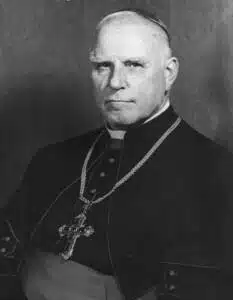
Bishop von Galen’s resistance to the Nazi Regime:
1933 – Refuses to follow the instructions of the Nazi school superintendent to amend the Religious Education lessons in Catholic Schools.
1934 – Begins preaching in opposition to Nazi racial ideological beliefs.
1934 – Sermon denouncing Rosenberg’s ideology. This results in the SS visiting von Galen to pressure him into preaching in favour of the ideas. Instead, von Galen denounces the Nazi Party when questioned.
1936 – Bishop von Galen leads public demonstrations against the Nazi decision to remove the Crucifix from all schools.
1937 – Along with Bishop Preysing, von Galen writes the draft of the Papal Epipliscal, “With burning Anxiety”
1937 – With Burning Anxiety (Mit brennender Sorge) read in all Catholic Churches in Germany.
1941 – Denounces the Euthenasia program and the actions against the Church in the East. A series of powerful sermons earns him the nickname “The Lion of Munster”
1941 – Nazi leaders and officials discuss methods of dealing with von Galen. Suggestions included execution and forced removal from office. Due to his popularity with the people of Westphalia, he was not arrested as the leadership feared unrest in a heavily Catholic area if he was deposed.
1941 – Copies of von Galen’s sermons – which refer to murderous policies – are circulated throughout the Reich and occupied territoies. They are known to have reached the front lines on the Eastern Front and Karol Wojtyla (who later became Pope John Paul II) is said to have read them whilst a young man living in Krakow.
Legacy of Bishop von Galen
Bishop von Galen’s sermons inspired other resistance. The Lubneck Martyrs were said to be inspired by his sermon. The first pamphlet distributed in Munich by the White Rose Movement was a copy of one of his sermons.
The above is a rather brief run through of the main ways in which von Galen resisted the regime. He was made a Cardinal shortly after the end of the war.
Germany 1919 – 1945 Links
The Second Reich
Unification of Germany – Political systems within the Second Reich – German Society during the Second Reich – Collapse of the Second Reich
Weimar Republic
Interim Government – Founding of the Weimar Republic – Impact of the First World War on Germany – The Treaty of Versailles and its impact on Germany – Weimar Constitution – 1919-1923: Years of Crisis? – Spartacist Uprising – Kapp Putsch – Reichsbanner Schwarz-Rot-Gold – Reparations – Hyperinflation in Germany, 1923 – 1924-1928: A Golden Era? – 1925 Presidential Election – Gustav Stresemann – German Foreign Relations 1919-1932 – Germany in the Great Depression – Failings of the Weimar Republic – Dada Movement
Rise of the Nazi Party
The Munich Putsch – Did the Economic Crisis of 1923 help the Nazi’s? – Origins of the Nazi Party – Rise of the Nazi Party
Nazi Germany
Totalitarian Regime in Nazi Germany – How did Hitler consolidate power? – Mein Kampf – Nazi methods of control – Opposition to the Nazi Regime – Organisation of the Nazi Party – Fuhrerprinzip – Kristallnacht – Youth and Education – Goering and the 2nd 4 Year Plan – Anti-Jewish Boycott, 1933 – Nazi Anti-Semitism – DAF (The German Labour Front) – Propaganda in Germany 1919-39 – Economic Policy of the Nazi Party – Kreisau Circle – The Confessing Church – Catholic Church – Edelweiss Pirates
Biographies
Ludwig Beck – Dietrich Bonhoeffer – Bishop Clemens von Galen – Carl Goerdeler – Robert Ley – Helmuth von Moltke – Martin Niemoller – Erwin Rommel – Hjalmar Schacht – Sophie Scholl – Albert Speer – Claus von Stauffenberg – Fritz Todt