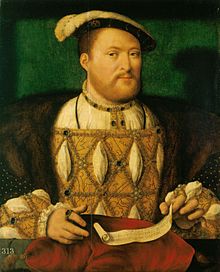
Henry VIII (1491–1547) was King of England from 1509 until his death. His reign transformed the monarchy, the Church and England’s relationship with Europe. Remembered for his six marriages, Henry also expanded royal power, dissolved the monasteries, developed the navy and broke with the authority of the Pope. His decisions shaped the reigns of his three children, Edward VI, Mary I and Elizabeth I, and changed the course of the Tudor dynasty.
Early life and accession to the throne
Henry was born at Greenwich Palace on 28 June 1491, the second son of Henry VII and Elizabeth of York. He was not originally expected to become king. His older brother, Arthur, was the heir to the throne, but Arthur died in 1502, leaving Henry as the next in line.
Henry VIII became king in April 1509, aged seventeen. His accession was welcomed by many people who hoped that the new monarch would be more generous and less restrictive than his father. Henry was athletic, enjoyed music and hunting, and cultivated an image of a vigorous Renaissance prince.
His early government relied heavily on experienced ministers. Thomas Wolsey eventually became the dominant figure in royal administration, handling domestic government and foreign policy. Henry initially showed less interest in the routine work of government than in warfare, diplomacy, sport and court life. Nevertheless, he remained the ultimate authority and increasingly expected ministers to carry out his wishes.
Marriage to Catherine of Aragon and the succession
Henry married Catherine of Aragon in June 1509. Catherine had previously been married to Henry’s elder brother Arthur, who died before becoming king. A papal dispensation had permitted the marriage between Catherine and Henry, helping maintain the diplomatic relationship with Spain.
The survival of the Tudor dynasty became one of Henry’s central concerns. Catherine gave birth to several children, but most died in infancy. Their surviving daughter, Mary, was born in 1516. Henry wanted a legitimate son who could succeed him, fearing that a disputed succession might lead to instability or renewed conflict.
During the 1520s, Henry became determined to end his marriage to Catherine and marry Anne Boleyn. He argued that his marriage to Catherine had been invalid because she had previously been married to his brother. The Pope would not grant the annulment Henry wanted, and the dispute became entangled in European politics, particularly the influence of Catherine’s nephew, Charles V, Holy Roman Emperor.
The failure to secure an annulment through Rome became a turning point. Henry’s determination to control his marriage ultimately led to a much wider transformation of religious authority in England.
The break with Rome
The Split with Rome was one of the defining events of Henry VIII’s reign. In 1533, Thomas Cranmer, Archbishop of Canterbury, declared Henry’s marriage to Catherine invalid. Henry married Anne Boleyn, and their daughter Elizabeth was born later that year.
In 1534, Parliament passed the Act of Supremacy, recognising Henry as the supreme head of the Church of England. The authority of the Pope over the English Church was rejected, and the Crown assumed control over religious institutions within the kingdom. Those who refused to accept the new arrangements could face severe penalties.
Henry’s break with Rome did not mean that he accepted all the teachings of Protestant reformers. Earlier in his reign he had opposed Martin Luther’s ideas and defended traditional Catholic doctrine. His religious policies were driven substantially by royal authority, the annulment dispute and control over the Church, rather than by a straightforward commitment to Protestant theology.
The Protestant Reformation nevertheless accelerated in England as a consequence of the break. The Crown gained control over the Church, while religious ideas, biblical translations and debates about doctrine continued to change. Henry’s successors would take England in different religious directions, producing further conflict and persecution.
The dissolution of the monasteries
Between 1536 and 1540, Henry’s government dissolved England’s monasteries and transferred their property to the Crown. This process, known as the Dissolution of the Monasteries, was one of the most significant social and economic changes of the reign.
The government initially ordered inspections of religious houses, examining their conduct and finances. Smaller monasteries were suppressed first, followed by the larger institutions. Their lands, buildings and wealth were taken into royal ownership, although some property was subsequently sold or granted to nobles and other supporters of the Crown.
The dissolution increased the Crown’s resources and changed patterns of landownership. It also brought an end to many monasteries that had provided religious services, education, hospitality and assistance to the poor. The effects varied between communities, but the loss of monastic institutions changed local life across England and Wales.
Opposition to the religious changes and the dissolution contributed to the Pilgrimage of Grace in 1536, a major rising in northern England. The rebels objected to the closure of monasteries, religious reforms and aspects of royal government. Henry’s government eventually suppressed the movement, and its leaders were punished.
Henry VIII’s six wives
Henry’s marriages were closely connected to the succession, diplomacy and the politics of his court. His six wives were Catherine of Aragon, Anne Boleyn, Jane Seymour, Anne of Cleves, Catherine Howard and Catherine Parr.
Catherine of Aragon’s marriage was annulled after years of dispute. Anne Boleyn was executed in 1536 after being accused of treason and adultery. Jane Seymour, Henry’s third wife, gave birth to the long-awaited male heir, Edward, in 1537, but died shortly afterwards.
Henry’s fourth marriage, to Anne of Cleves, was arranged for diplomatic reasons and was annulled in 1540. His fifth wife, Catherine Howard, was executed for treason in 1542. His sixth wife, Catherine Parr, survived him and played a role in bringing his surviving children closer together.
These marriages were not simply personal affairs. They affected alliances, court factions, religious policy and the succession. The fall of powerful figures such as Anne Boleyn and the execution of nobles accused of opposing the king illustrate the dangers of life at Henry’s court.
Government, ministers and royal authority
Henry VIII strengthened the power of the Crown and used Parliament to give legal authority to major changes. The break with Rome, the transfer of church property and alterations to the succession were all enacted through legislation. Parliament became an important instrument of royal policy, even though Henry retained decisive authority.
Thomas Wolsey served as Henry’s leading minister for much of the early reign. His influence declined when he failed to secure the annulment of Henry’s marriage. Thomas More, who opposed the royal supremacy over the Church, was executed in 1535. Thomas Cromwell then became central to the implementation of the religious changes and the dissolution of the monasteries, but he too fell from favour and was executed in 1540.
Henry’s government could be highly effective, but it was also coercive. Treason laws and the use of execution against perceived opponents reinforced the risks of challenging royal authority. The execution of Margaret Pole, Countess of Salisbury, in 1541 was one example of the treatment of members of families whose ancestry or political connections could be regarded as a threat.
Royal authority also expanded in Wales. The Acts of Union with Wales in the 1530s brought Welsh administration and representation more closely into the English legal and political system.
War, diplomacy and the navy
Henry VIII sought military success and prestige abroad. England fought campaigns against France and Scotland, although these wars placed heavy demands on royal finances. The king’s meeting with Francis I of France at the Field of the Cloth of Gold in 1520 demonstrated the importance he attached to royal magnificence and diplomacy.
Relations with Scotland deteriorated into renewed conflict. English forces defeated the Scots at the Battle of Flodden in 1513, during Henry’s first campaign against France. Later, Henry attempted to secure a marriage between his son Edward and Mary, Queen of Scots. When Scottish resistance prevented the proposed alliance, England launched a series of attacks known as the Rough Wooing.
Henry also invested in naval power. Warships, coastal defences and dockyard facilities became increasingly important to the Crown’s military planning. The Mary Rose, launched during Henry’s reign, became the best-known vessel of his navy. It sank in the Solent in 1545 during a confrontation with a French fleet.
Warfare strengthened the king’s image as a military ruler but also contributed to financial pressure. Campaigns required taxation, borrowing and the use of revenue from the dissolution of the monasteries. Henry’s wars achieved some successes but did not establish lasting English control over France or Scotland.
Royal finances and the economy
Henry inherited a monarchy with comparatively strong finances, but his ambitions were expensive. Court expenditure, military campaigns, fortifications and the maintenance of a growing navy all required substantial revenue.
The dissolution of the monasteries brought large amounts of land and wealth into royal hands. However, the proceeds were not sufficient to meet all the costs of government and warfare indefinitely. Henry sold or granted many former monastic estates, reducing the long-term income that might otherwise have come from retaining them.
The government also debased the coinage during the later years of the reign, reducing the precious-metal content of some coins. This helped raise short-term revenue but contributed to economic difficulties and inflation. Financial pressures were one of the major problems inherited by Edward VI’s government in 1547.
Family, succession and the final years
Henry’s three surviving children were Mary, Elizabeth and Edward. Each would become monarch, although their religious beliefs and political circumstances differed greatly. Mary and Elizabeth were declared illegitimate at different stages of Henry’s reign, but both were later restored to the succession.
The succession was a continuing concern. Edward, born in 1537, was Henry’s only legitimate son to survive infancy. Henry’s later years were marked by declining health and renewed military campaigns. He died on 28 January 1547 and was buried at St George’s Chapel, Windsor Castle, beside Jane Seymour.
Edward VI succeeded him at the age of nine. The young king’s reign brought further Protestant reforms, while Mary’s later accession restored Catholic worship for a time. Elizabeth’s reign would establish a more lasting religious settlement. The religious and political changes initiated under Henry therefore continued long after his death.
Henry VIII’s legacy
Henry VIII left a lasting mark on English history. His break with Rome transformed the relationship between monarchy and Church, while the dissolution of the monasteries reshaped landownership and local society. His use of Parliament helped establish important precedents for the exercise of royal authority, although his government also relied heavily on coercion and punishment.
His six marriages and the succession shaped the course of the Tudor dynasty. Edward VI, Mary I and Elizabeth I inherited a kingdom altered by religious change and political upheaval. Their reigns would bring further reforms, reversals and conflicts.
Henry remains a controversial figure because his achievements were accompanied by executions, religious persecution, financial strain and the destruction of religious institutions. Understanding his reign requires looking beyond the familiar story of his marriages to the wider changes in government, religion, warfare and society that made his rule a turning point in English history.
Further Reading
- G. W. Bernard, “The Dissolution of the Monasteries”. History, 96, no. 324 (2011), pp. 390–409.
- Richard Rex, “The Lost Breviarium Compertorum and Henry VIII’s First Act for the Dissolution of the Monasteries, 1536”. The Journal of Ecclesiastical History, 74, no. 4 (2023), pp. 738–752.
- Retha M. Warnicke, “Queenship: Politics and Gender in Tudor England”. History Compass, 4, no. 2 (2006), pp. 203–227.
- Grace Beattie, “Divorced, beheaded … survived: what the six wives of Henry VIII can tell us about ourselves”. Women’s History Review, 34, no. 2 (2025), pp. 346–353.