Medicine in ancient Greece developed through observation, practical experience, religious healing and philosophical debate. As part of the wider history of Medicine Through Time, Greek medicine inherited knowledge from earlier civilisations, including Egypt, while developing its own explanations of illness and approaches to treatment. Some medical writers increasingly sought natural causes for disease by examining symptoms, diet, lifestyle and the environment rather than relying solely on supernatural explanations. Religious healing remained important, and different approaches existed alongside one another.
Ancient Greek medicine influenced medical thinking and medical practice for centuries. Writings associated with Hippocrates encouraged careful observation of patients, while the Theory of the Four Humours shaped explanations of health and disease. Greek medical ideas were later adopted, debated and adapted by Roman physicians and remained influential during the Middle Ages.

Ancient Greek medicine
There was no single system of medicine followed by all ancient Greek physicians. Some practitioners emphasised observation and natural explanations of illness, while others relied on inherited traditions, religious practices or particular theories about the body. Surviving medical writings reveal disagreements between authors as well as changes in medical thought over time.
Greek medicine developed within a wider Mediterranean world. Egyptian medical texts recorded diagnoses, prescriptions and treatments long before the rise of classical Greek medicine. Contact between societies provided opportunities for knowledge to be exchanged, although the precise influence of Egyptian practices on particular Greek medical ideas is not always easy to establish. Earlier developments are examined in Ancient Egyptian Medicine.
Religion and healing in ancient Greece
Religion remained an important part of medical treatment in ancient Greece. Asclepius, the god of medicine and healing, was worshipped at sanctuaries where people sought help with illness and injury. The Cult of Asclepius became particularly prominent, with major healing centres attracting visitors who hoped for recovery through divine intervention.

Patients visiting an Asclepian sanctuary might make offerings, participate in rituals and sleep in a sacred area in the hope of receiving a healing dream. This practice, known as incubation, was associated with divine guidance and recovery. These sanctuaries were religious centres rather than modern hospitals, although their activities could include practical care and treatments as well as ritual healing.
Religious healing and medicine based on observation were not necessarily regarded as opposites. People could seek divine assistance while also consulting a physician. This coexistence is an important feature of ancient Greek medicine and helps explain why religious beliefs continued to influence healing as medical writers developed natural explanations for disease.
Hippocrates and the development of medical reasoning
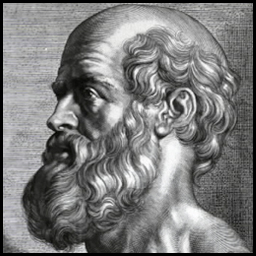
Hippocrates was a Greek physician traditionally dated to the fifth and fourth centuries BC. He became known as the Father of Medicine because of his association with an influential tradition of medical writing. However, many works attributed to Hippocrates were written by different authors, and the entire collection cannot be assigned to one individual.
The Hippocratic Corpus contains writings about symptoms, diagnosis, prognosis, surgery, diet and the course of particular illnesses. These works encouraged physicians to observe patients, record changes in their condition and consider how illness developed. Some texts attempted to explain disease through natural processes rather than attributing every condition to divine punishment or supernatural intervention.
This approach was significant because it encouraged explanations that could be examined and debated. Nevertheless, Hippocratic medicine was not equivalent to modern scientific medicine. Its writers had limited knowledge of anatomy, physiology and the causes of infection, and their explanations could be mistaken. Its historical importance lies in the methods of observation and reasoning represented in the writings, not in the assumption that every conclusion was correct.
The Theory of the Four Humours
The Theory of the Four Humours became one of the most influential explanations of health and disease in ancient Greek medicine. It proposed that the body contained four principal fluids: blood, phlegm, yellow bile and black bile. Health was understood as a balance between these humours, while illness was associated with an imbalance.
Humoral theory influenced explanations of symptoms and the choice of treatments. Physicians might recommend changes to diet, exercise or daily routines in an attempt to restore balance. Treatments could also include medicines intended to remove what was considered an excess of a particular humour.
The theory was not a single, unchanging doctrine, and ancient medical writers disagreed about how the body worked. Nevertheless, humoral explanations remained influential for many centuries. Their persistence illustrates how a theory could shape medical practice even when its underlying assumptions were not supported by modern evidence.
Public health in ancient Greece
Health was influenced by living conditions, food, water, exercise and the surrounding environment. Greek medical writers discussed the effects of climate, location and lifestyle on wellbeing. These ideas are explored further in Public Health in Ancient Greece, although facilities and practices varied between communities.
Greek cities did not have a single, coordinated public-health system comparable to those developed by modern states. Some communities invested in water supplies, drainage, baths and other facilities, while access and conditions differed according to place and period. Religious sanctuaries also provided organised settings in which people could seek healing, but they should not be described as modern hospitals.
Greek ideas about diet and the environment continued to influence later medical writing. The Hippocratic tradition treated lifestyle as an important part of health, although its recommendations were based on the knowledge and assumptions of the period rather than modern nutritional or medical science.
Why was ancient Greek medicine important?
Ancient Greek medicine contributed to the history of medical reasoning through its written descriptions of illness, attention to symptoms and attempts to explain disease through natural causes. It also preserved competing ideas about the body, including humoral theory, and maintained religious approaches to healing. These traditions coexisted rather than following a simple progression from superstition to science.
Greek medical ideas spread throughout the Mediterranean world and were adopted and adapted by Roman physicians. Roman medicine drew heavily on Greek medical writing while developing practices of its own in areas such as military medicine and public health. The physician Galen later became one of the most influential writers in this tradition.
Greek medical texts continued to be copied, translated and studied during the Middle Ages. Their ideas were interpreted by scholars in different cultural settings, and some remained influential into the Renaissance. Studying these developments helps historians understand continuity and change: medical ideas could be preserved for centuries, adapted to new circumstances or eventually rejected as knowledge changed.
Ancient Greek medicine is important not because it was the same as modern medicine, but because its writers developed influential ways of describing illness, reasoning about treatment and recording medical ideas. Comparing Greek medicine with Egyptian medicine, later Roman practice and medieval developments helps explain how medical knowledge was transmitted, challenged and transformed over time.
Further Reading
- National Library of Medicine, Greek Medicine.
- Laurence Totelin, University of Cambridge, Food and medicine in classical Greece: the ‘blurred boundary’.
- UNESCO World Heritage Centre, Sanctuary of Asclepios at Epidaurus.